
If you run a window, door, or curtain wall fabrication shop, you already know one truth: cutting speed and angle accuracy directly determine your daily output and profit margin.
One wrong miter cut on an aluminum frame, and you’re scrapping material, reworking the piece, and pushing delivery dates back. For PVC profiles, chipped edges or uneven cuts mean poor corner joints and callbacks from clients.
That’s why more and more small-to-mid size fabricators are replacing their single-head saws with a CNC double head cutting saw with 45° and 90° dual-angle capability. It’s not another fancy piece of equipment — it’s a productivity upgrade that pays for itself faster than you might think.
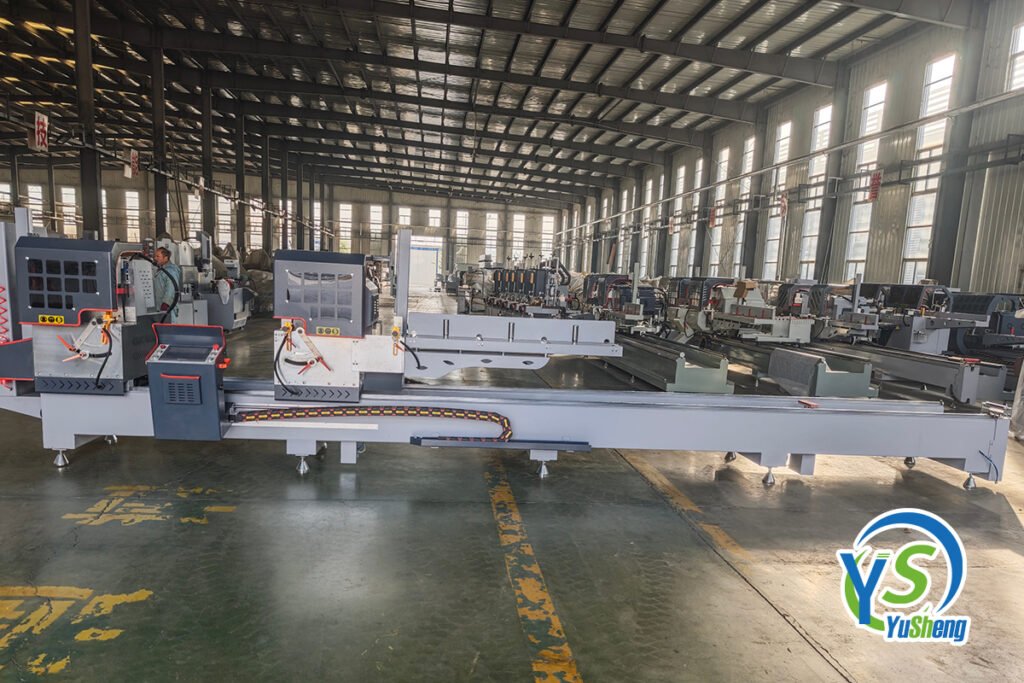
What Exactly Is a Dual-Angle CNC Double Head Saw?
Let’s break it down in plain terms.
A double head saw has two independent cutting heads mounted on a single bed. Instead of cutting one end of a profile, flipping it, and cutting the other end manually, you position the profile once and both heads cut simultaneously.
The “45°/90° dual-angle” part means each head can quickly pivot between a straight 90° cut and a 45° miter cut — no tools, no manual protractor, no guesswork.
Add a CNC control system on top, and the machine handles length positioning, angle locking, and feed speed automatically. An operator types in the dimensions on a touchscreen, loads the profile, and presses start.
It sounds simple on paper, but the ripple effect on your production line is huge.
Why 45° and 90° Are the Only Angles Most Shops Actually Need
Walk onto any aluminum window or PVC door production floor, and you’ll see the same two cuts repeated all day, every day:
- 90° straight cuts for mullions, transoms, and straight profile sections
- 45° miter cuts for frame corners where two pieces join at a right angle
Some machines advertise “any angle from 0° to 180°,” but here’s the reality: most fabricators use 45° and 90° for 95% of their jobs. Full variable-angle saws cost more, require more calibration, and introduce more points of potential error.
A dedicated dual-angle machine locks into 45° and 90° with precision mechanical positioning. The angle stays consistent cut after cut, shift after shift. For frame fabrication, that level of repeatability matters more than having 50 rarely-used angle presets.
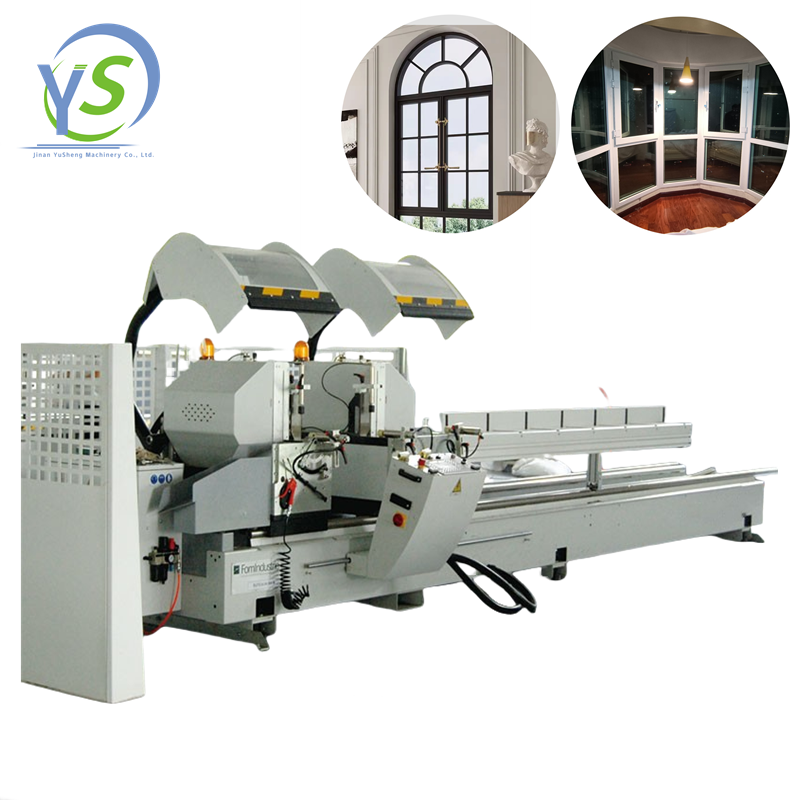
Aluminum vs. PVC: One Machine, Two Materials, Zero Compromise
One of the biggest advantages of a modern double head saw is that it handles both aluminum alloy profiles and PVC plastic profiles without skipping a beat.
For aluminum profiles
Whether you’re working with thermal-break aluminum window frames, curtain wall extrusions, or industrial aluminum frames, the saw uses a carbide-tipped blade running at the correct RPM. The result is a clean, burr-free cut edge that’s ready for assembly — no deburring step required.
A good machine also includes a dust collection hood. Aluminum chips are abrasive and messy. Containing them at the source protects both your equipment and your operators.
For PVC profiles
PVC is softer, but it has its own challenges. Cut too aggressively and you get chipped corners, melted edges, or profile deformation.
Quality dual-head saws use a low-vibration cutting design and controlled feed rate specifically tuned for plastic profiles. The pneumatic clamping system holds the profile securely without crushing it, so every miter joint fits tight and clean.
For shops that fabricate both aluminum and uPVC products, this dual-material capability means one machine covers two production lines.
The CNC Difference: Stop Measuring, Start Cutting
If you’re still using a manual tape measure and a manual saw, you’re leaving money on the table. Here’s what CNC control changes on a practical level:
No more marking errors. An operator inputs the target length once, and the servo-driven positioning system moves the head to the exact spot. Length accuracy lands within ±0.1mm on well-built machines.
Batch cutting is effortless. Need 200 pieces of the same frame rail? Input the quantity and the machine cycles through automatically. Your operator can focus on loading and unloading instead of measuring every single piece.
Parameter memory saves setup time. Switching from a 60mm window profile to a 90mm curtain wall profile? Recall the saved settings from the touchscreen instead of re-calibrating everything by hand.
For shop owners, the math is straightforward: fewer measurement mistakes = less scrap = higher margin per job.

What to Look for When You’re Comparing Machines
Not all double head saws are built the same. If you’re in the market, prioritize these features:
- Servo motor feeding, not just pneumatic. Servo positioning is faster, more accurate, and holds tolerance better over years of use.
- Linear guide rail transmission. It’s smoother and more durable than round-bar guides, especially for high-volume production.
- Pneumatic clamping with adjustable pressure. Softer PVC profiles need lower clamping force; aluminum needs more. Adjustable pressure means you don’t damage either material.
- Built-in dust extraction port. Your workshop air quality and saw blade lifespan will both thank you.
- Intuitive CNC interface in your language. A complicated control panel defeats the purpose of automation — operators should be able to learn it in a day, not a week.
Is It the Right Upgrade for Your Shop?
If your shop produces window frames, door frames, curtain wall sections, or any other profile-based products where 45° and 90° cuts make up the majority of your work, the answer is almost certainly yes.
A 45°/90° CNC double head cutting saw doesn’t just cut profiles faster — it standardizes quality across every operator, reduces material waste, and frees up your senior staff to focus on higher-value assembly work instead of measuring and re-cutting.
For small and medium fabrication businesses, it’s one of the highest-ROI equipment upgrades you can make. One machine replaces two single-head saws in output, takes up less floor space, and produces more consistent results from day one.

