
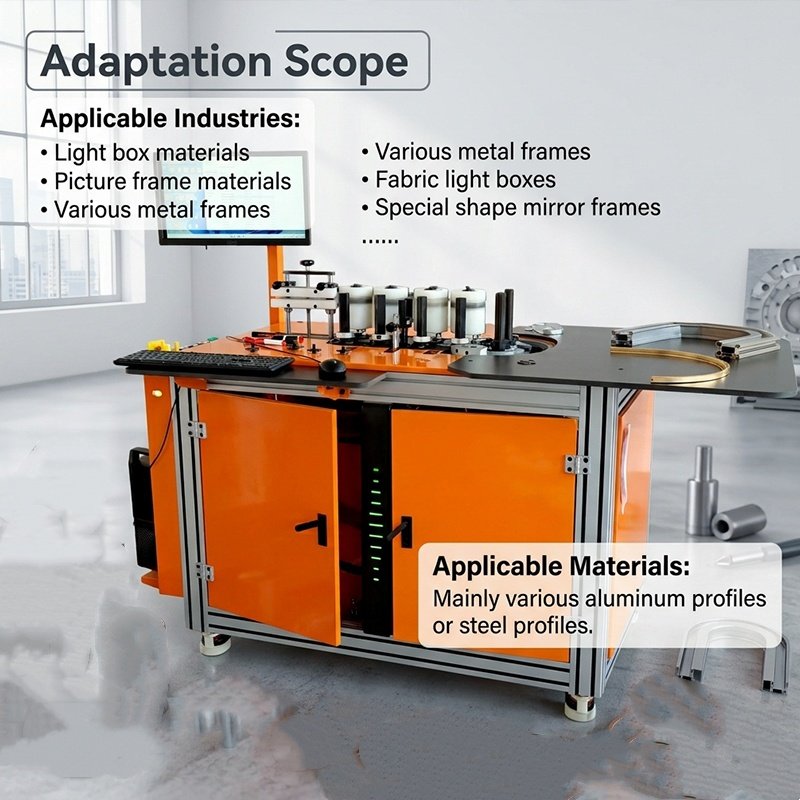
Light box frame manufacturing has long been plagued by accuracy bottlenecks. Whether for outdoor advertising light boxes, backlit signage frames, or slim LED display enclosures, inconsistent bending angles, uneven seam gaps, and twisted frame profiles lead to high reject rates, extra rework time, and delayed client deliveries. Many fabricators still rely on traditional single-direction bending equipment, which struggles to produce symmetrical mirror-style metal profiles efficiently. This is where the CNC bidirectional mirror metal frame bending machine changes the game for light box frame production.
Why Traditional Bending Falls Short for Light Box Frames
Light box frames demand tight dimensional consistency. The finished metal profile must match perfectly at joining corners to create clean, flush seams. Older bending machines only bend from one side. Operators need to flip, re-clamp, and reposition the workpiece repeatedly for symmetrical mirror bends. Every repositioning introduces alignment errors.
Common pain points in conventional workflow:
- Angle deviation after multiple re-clamping
- Uneven frame lengths causing poor assembly fit
- Visible gaps at corner joints on finished light boxes
- Slow production speed, especially for batch orders of mirror paired profiles
- Heavy reliance on skilled operators to adjust offsets manually
These issues cut into profit margins. Scrap material and rework labor quickly add up, especially for large light box projects with strict tolerance requirements.
CNC Bidirectional Mirror Metal Frame Bending Machine: How It Fixes Accuracy Problems
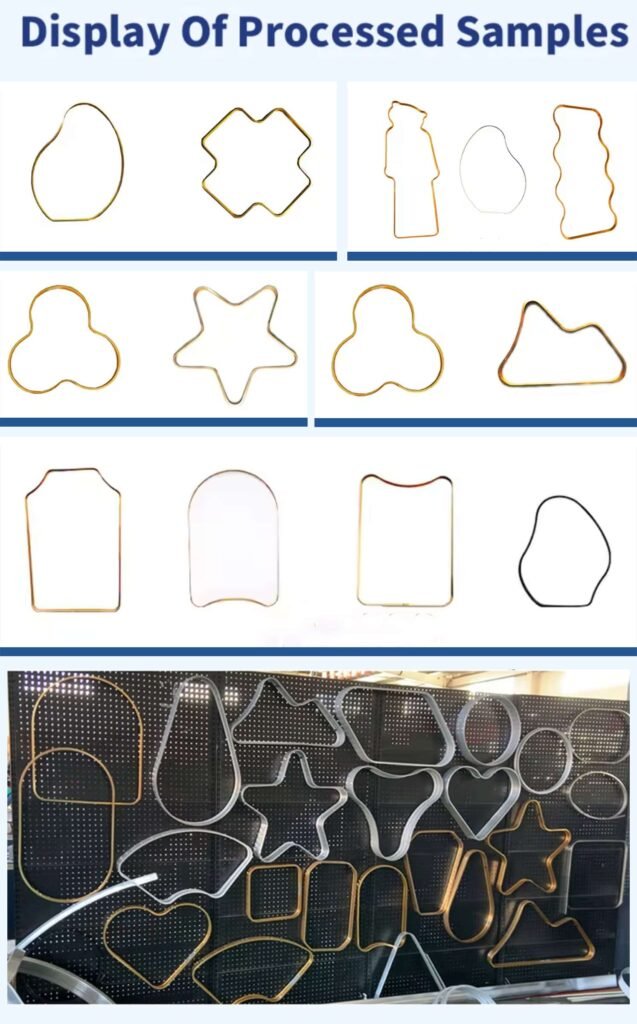
The core advantage of this CNC bidirectional mirror bending equipment lies in its ability to form symmetrical mirror bends on metal strips in one single clamping setup. Once the aluminum or steel profile is fixed, the machine executes bending on both sides without manual workpiece flipping.
Controlled by dedicated CNC programming, the system precisely sets bending positions, bend angles, and feed lengths. Every frame piece in the same batch maintains identical dimensions. For light box frames that require left-right mirror profiles, the machine can output matched pairs directly.
Key performance benefits for light box fabricators:
- Higher dimensional accuracy: Eliminates alignment errors from repeated repositioning. Corner gaps stay within minimal tolerances for seamless assembly.
- Consistent mirror profile output: Produces perfectly symmetrical frame halves, ideal for slim light boxes and backlit sign frames.
- Reduced material waste: Fewer defective parts mean less scrap aluminum and lower raw material costs.
- Faster cycle time: Cuts down manual handling steps, boosting daily output for bulk orders.
- Lower operator skill dependency: Recipes can be saved in the CNC system. New operators can run repeat jobs reliably after basic training.
This machine works well with common light box frame materials including aluminum alloy strips, thin galvanized steel, and stainless steel profiles. It supports varied frame sizes used in retail signage, airport light boxes, commercial backlit advertising panels and indoor decorative light enclosures.
Real-World Benefits for Light Box Manufacturers
Sign and light box fabricators face growing pressure from customers for tighter tolerances, faster lead times and cleaner finished aesthetics. Customers reject light boxes when frame corners do not fit neatly, or when warping distorts the front panel installation.
Upgrading to CNC bidirectional mirror metal frame bending equipment removes those headaches. Shops can quote more confidently on high-precision projects, reduce rework overhead, and improve finished product quality. For custom light box orders with non-standard sizes, the CNC control allows quick parameter adjustment without extensive tooling changes.
Final Thoughts
Frame accuracy remains one of the biggest limiting factors in light box fabrication. Traditional single-side bending cannot easily deliver consistent mirror metal profiles at scale. Investing in a CNC bidirectional mirror metal frame bending machine addresses core processing flaws at the source. It stabilizes quality, speeds up production, and gives light box manufacturers a competitive edge in the signage market.
If your workshop struggles with inconsistent bending results, frequent frame rework and slow output of symmetrical light box profiles, this CNC bending solution is worth evaluating for your next equipment upgrade.

