
If you’ve shopped contemporary bathroom mirrors, wall art frames or vanity photo borders lately, you’ve likely noticed a clear design shift: sharp 90-degree square corners are gradually giving way to soft rounded edges, oval outlines and seamless curved aluminum frames. This aesthetic upgrade does not rely on manual welding or plastic molding; it is entirely enabled by mature aluminum profile bending technology tailored exclusively for mirror and photo frame production.
For frame factories, interior decor suppliers and custom metal fabricators worldwide, mastering profile bending is no longer a bonus feature—it has become a core competitive edge to capture high-end home decor, hotel renovation and retail display orders. Over years serving frame manufacturers from Europe, Southeast Asia and the Middle East, we’ve found most production headaches stem from poor bending precision, uncontrollable springback, cracked profile surfaces or distorted hollow frame sections. Today we break down the practical bending techniques, process standards, material selection rules and production tips for aluminum mirror & photo frames, written for factory technicians, purchasing managers and decor business owners.
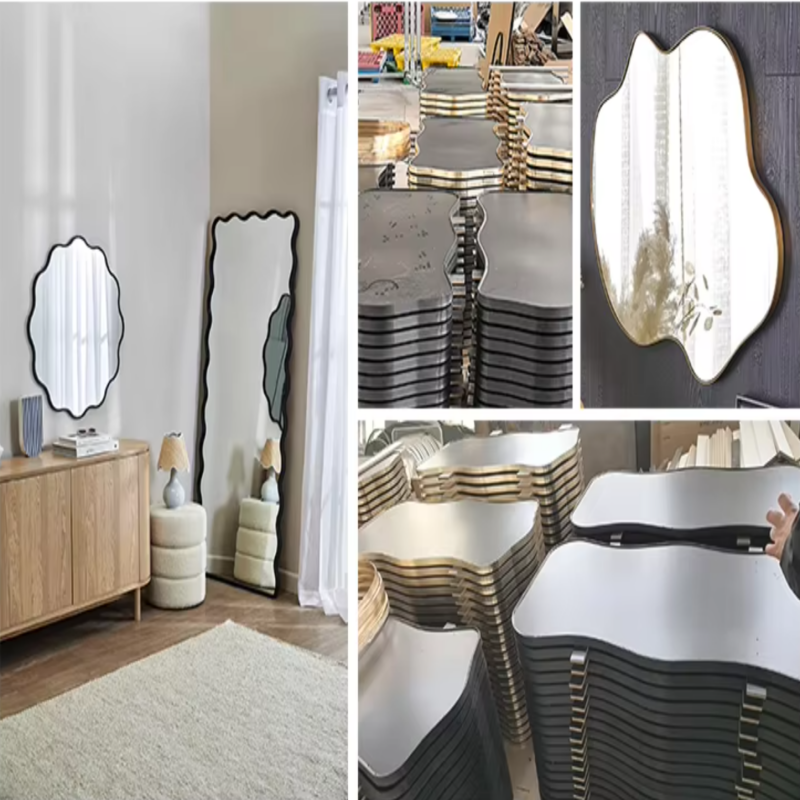
Why Aluminum Bending Dominates Mirror & Photo Frame Production
Wood frames warp in humid bathrooms, steel frames rust easily and plastic frames lack premium texture. Bent aluminum profiles solve all these pain points while unlocking curved design possibilities:
- Moisture & rust immunity: Natural alumina film prevents corrosion, perfect for bathroom mirrors, shower area decorative mirrors and humid coastal interior projects. No rust spots even after 8–10 years of use.
- Lightweight yet rigid: A full-body mirror aluminum frame weighs only 1/3 of a steel counterpart, reducing wall load and lowering installation risks for large wall-mounted mirrors.
- Seamless curved aesthetics: Bending creates one-piece rounded corners without welding joints, eliminating rough weld seams that ruin the minimalist brushed metal finish.
- Rich customizable finishes: After bending, frames support anodizing, wire brushing, powder coating and wood grain transfer, covering gold, matte black, champagne silver, bronze and 30+ mainstream decor colorsAlibaba.co….
- 100% recyclable aluminum: Meets EU RoHS environmental standards, ideal for eco-friendly hotel and residential decoration projects.
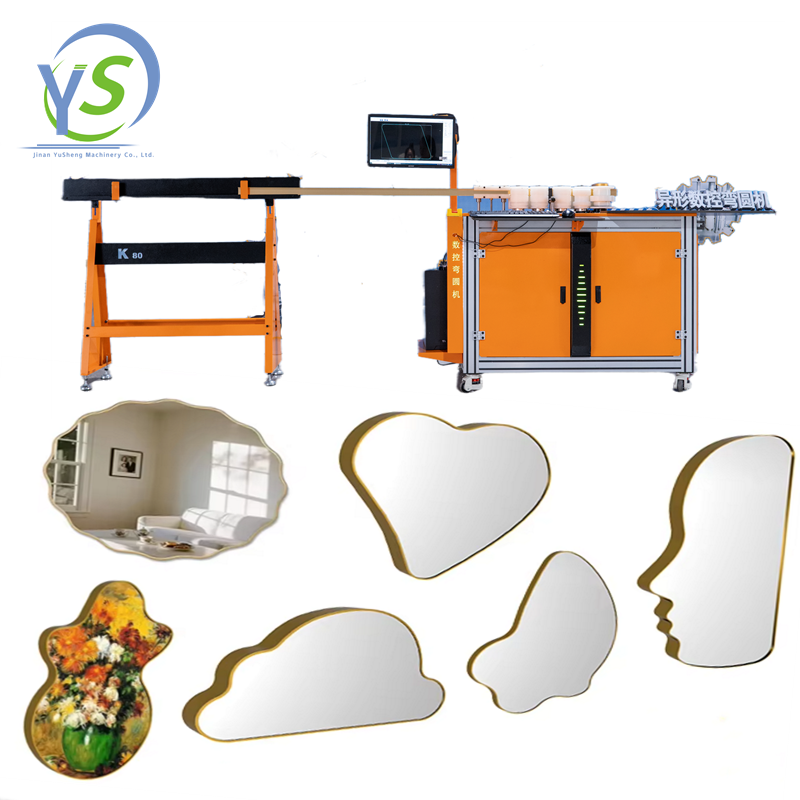
Main Bending Technologies Used For Mirror & Photo Frames
Frame aluminum profiles are mostly thin-walled hollow extrusions (wall thickness 0.3mm–1.2mm). Improper bending easily causes outer wall cracking, inner wall wrinkling and cross-section oval deformation. Three mature bending methods are widely adopted in the framing industry:
1. Rotary Draw Bending (Most Popular For Rounded Rectangle Mirror Frames)
This is the mainstream craft for making R30–R80 rounded corners for rectangular mirror frames. The aluminum profile is tightly clamped to a fixed rotary die and pulled for bending under servo control.
- Advantages: Ultra-stable bend radius, minimal springback (<0.15mm per meter), no collapse of hollow profile cavity, zero scratches on brushed surface.
- Application: Bathroom vanity mirrors, living room decorative painting frames, square photo frames with rounded corners (the most in-demand style in home decor markets).
2. 3/4-Roll Roll Bending (For Round Mirrors & Oval Photo Frames)
Three or four groups of precision rollers gradually extrude straight aluminum profiles into continuous arcs or full circles.
- Advantages: Produces complete circular mirror frames, long curved arch frames for decorative murals; flexible radius adjustment without custom dies for each size.
- Limitation: Not suitable for tiny tight corners below R25.
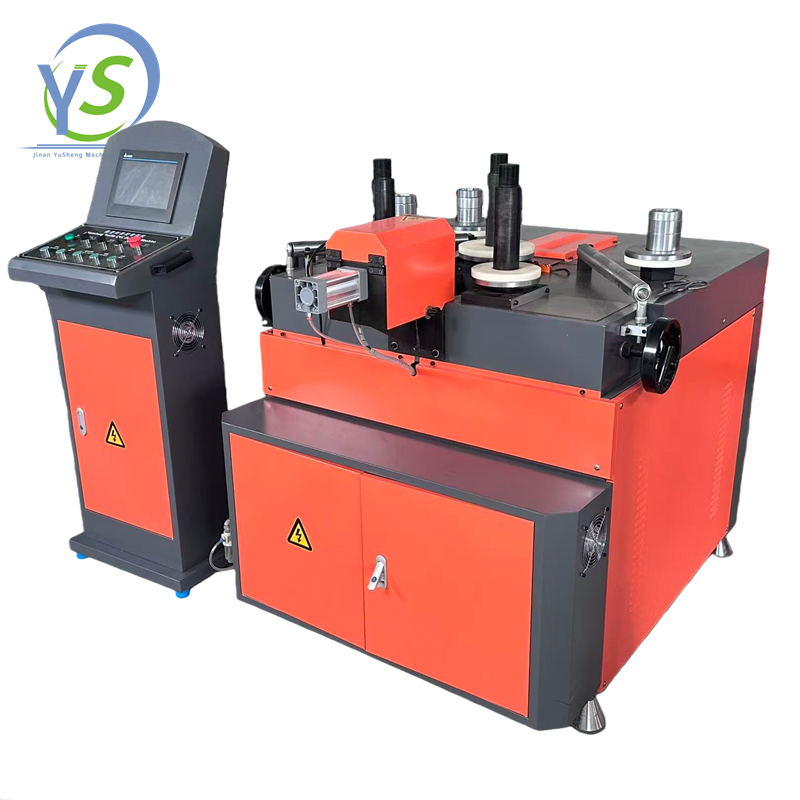
3. Cold Stretch Bending (Premium High-End Frames)
Add axial tension while bending the profile to offset material springback fundamentally. Curved frames formed this way have uniform internal stress, never rebound after long-term use, widely used for luxury villa decorative mirrors and gallery photo frames.
Hot bending is rarely used in framing production: high-temperature heating will destroy the pre-anodized surface of aluminum profiles, leading to discoloration and defective finished frames, so nearly all mirror frame bending adopts room-temperature cold bending process.
Standard Production Flow Of Bent Aluminum Frames
A complete standardized production line avoids defective curved frames and improves yield above 98%:
- Profile selection & cutting: Adopt 6063-T5 aluminum extrusion (the universal alloy for frames, balanced malleability and hardness); cut raw profiles to fixed lengths with precision saws, deburr all cut ends.
- Parameter simulation: Input target bend radius, profile wall thickness and section size into CNC bending system to pre-calculate springback compensation values (critical step to prevent corners from bouncing back out of tolerance).
- CNC precision bending: Closed-loop servo bending machine executes bending, real-time pressure monitoring to prevent hollow profile collapse.
- Calibration & shaping: Manual fine calibration for individual pieces to correct tiny dimensional deviations.
- Surface inspection: Check for outer layer cracking, indentations or wrinkling; reject flawed curved semi-finished products.
- Post-treatment: Anodizing/brushing/color coating → cutting assembly notches → packaging for final frame assembly.
Key Industry Threshold: Springback Control
Aluminum naturally springs back after bending, the top reason most small factories produce uneven rounded corners. Qualified frame bending equipment must support automatic springback compensation: modern CNC bending machines preset compensation coefficients according to 6063 aluminum properties, controlling finished corner tolerance within ±0.1mm, consistent for mass production batches.
Alloy & Profile Selection Rules To Avoid Bending Failure
Many manufacturers make the mistake of using hard 6061-T6 aluminum for mirror frames, resulting in frequent cracking during bending. Follow these material rules for stable production:
- Default alloy: 6063-T5 aluminum extrusion Best malleability for cold bending, resists cracking at R≥35 corners, cost-friendly for mass photo frame orders.
- Thin-wall profile limit: Do not bend hollow profiles thinner than 0.35mm with corners smaller than R30; ultra-thin profiles easily wrinkle on the inner bend side.
- For ultra-small rounded corners (R20–R30): Switch to solid aluminum strips instead of hollow profiles to avoid cavity deformation.
- Custom wide mural frames: Use reinforced ribbed aluminum profiles to keep curved frames from twisting after forming.
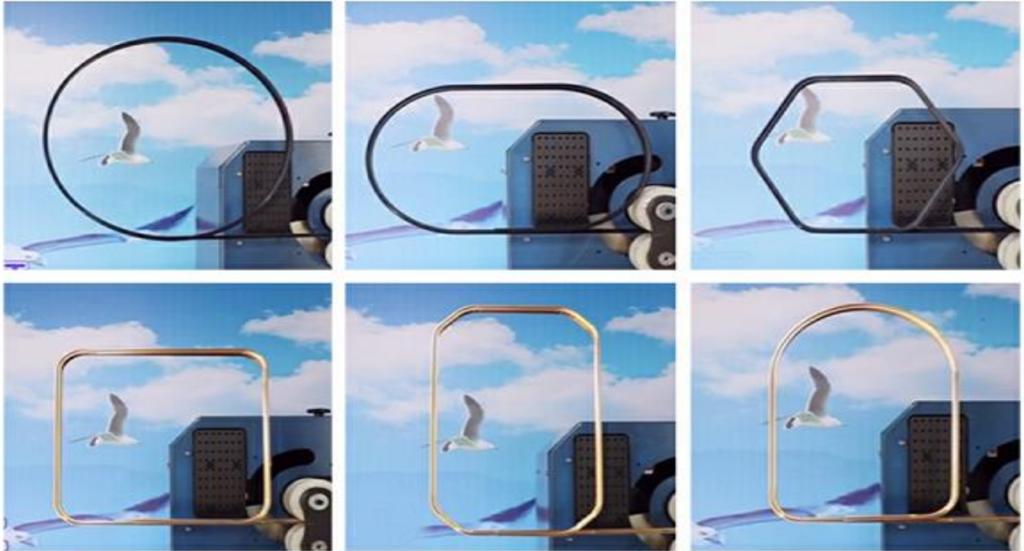
Market Application & Trend Of Bent Aluminum Frame Technology
- Residential decoration: Rounded rectangular bathroom mirrors dominate modern bathroom renovations; curved gold aluminum photo frames are mainstream social media viral decor styles.
- Commercial space: Hotel lobby curved mirror walls, clothing store fitting mirrors, gallery art painting frames all rely on bent aluminum profiles for seamless curved styling.
- Future development trend: More irregular curved frames, asymmetric arcs and ultra-narrow border curved mirror frames will become mainstream, pushing bending equipment toward multi-radius one-time forming intelligent CNC bending machines.
For frame factories still assembling frames with welded right-angle aluminum profiles, upgrading to CNC bending production can eliminate welding polishing processes, raise finished product grade and increase unit selling price by 15%–25% in overseas markets.
Final Tips For Buyers & Manufacturers
- When sourcing bent aluminum mirror frames, confirm whether the supplier uses rotary draw bending (seamless corners) or welded assembly (visible seams), seamless bent frames have better texture and durability.
- If you run a frame factory, invest in closed-loop CNC bending equipment instead of ordinary hydraulic benders; lower defective rates will greatly reduce long-term production costs.
- For custom special-shaped curved mirror frames, provide designers with the minimum bend radius of aluminum profiles first to avoid designing unprocessable shapes.
Aluminum profile bending is not just a metal forming process for mirror and photo frames — it bridges industrial precision manufacturing and home decor aesthetics. As minimalist curved design continues to occupy global interior decoration markets, mastering stable, low-defect aluminum bending technology will remain the core competitiveness of frame manufacturers worldwide.

