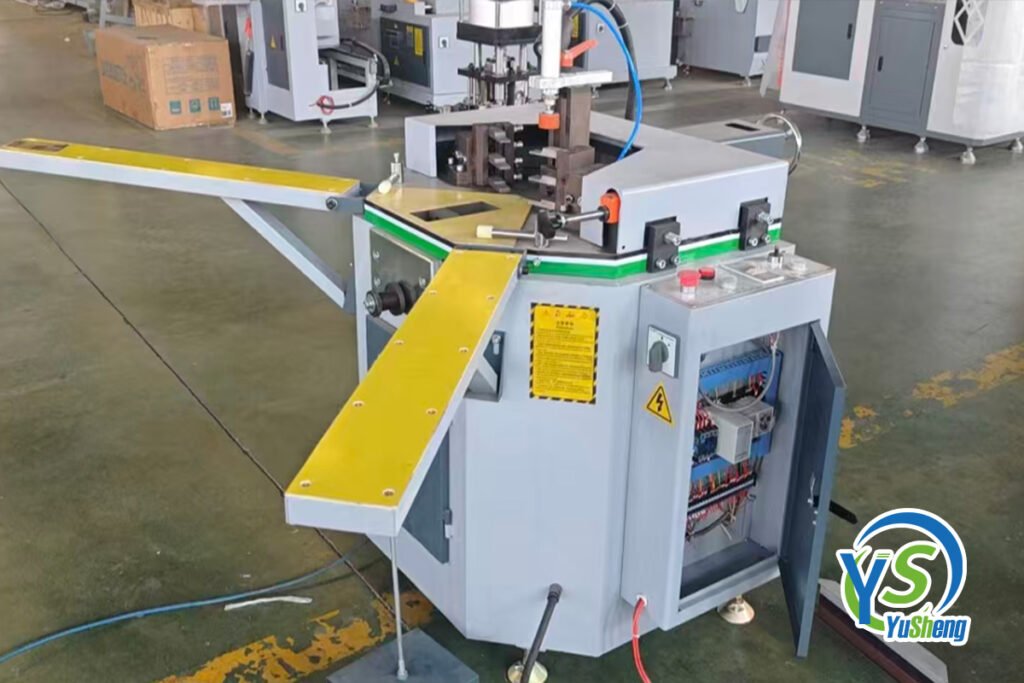
The Windows Doors Corner Crimping Machine is an essential piece of equipment in modern aluminum door and window manufacturing. Designed to create strong, seamless 90° joints, this machine ensures structural integrity while enhancing thermal efficiency by minimizing metal bridging. Below are its key features and applications:
Technical Specifications
- Functionality:
- Primarily used for extruding and connecting aluminum profiles into frames, replacing traditional welding or screw-fastening methods.
- Hydraulic systems enable precise adjustments for thicker or custom-angle profiles (e.g., 45°–90°).
- Advanced models feature CNC controls for automated, continuous feeding (e.g., LM4XA-CNC series).
- Performance:
- High-speed operation with double-point or step knives to reinforce corner strength.
- Positioning systems (e.g., lifting-type front mechanisms) streamline material handling.
- Compatibility:
- Adaptable to various profile thicknesses and designs, including casement windows and sliding doors.
Industrial Applications
- Large-Scale Production: Ideal for manufacturers requiring high-volume output with consistent precision.
- Energy-Efficient Solutions: Crimped joints reduce thermal leakage, meeting green building standards.
- Custom Fabrication: Supports bespoke designs for architectural projects.
Advantages Over Traditional Methods
- Efficiency: Processes corners in seconds, outperforming manual assembly.
- Durability: Creates joints resistant to weathering and mechanical stress.
- Cost-Effectiveness: Lowers labor costs and material waste.
Market Options
- Entry-level single-head machines (~$5,500) suit small workshops.
- Fully automated four-head CNC models (~$69,999) cater to industrial needs.
Conclusion
Corner crimping machines revolutionize aluminum fabrication by combining speed, precision, and sustainability. Whether for standard or custom profiles, they are indispensable in producing high-quality doors and windows.