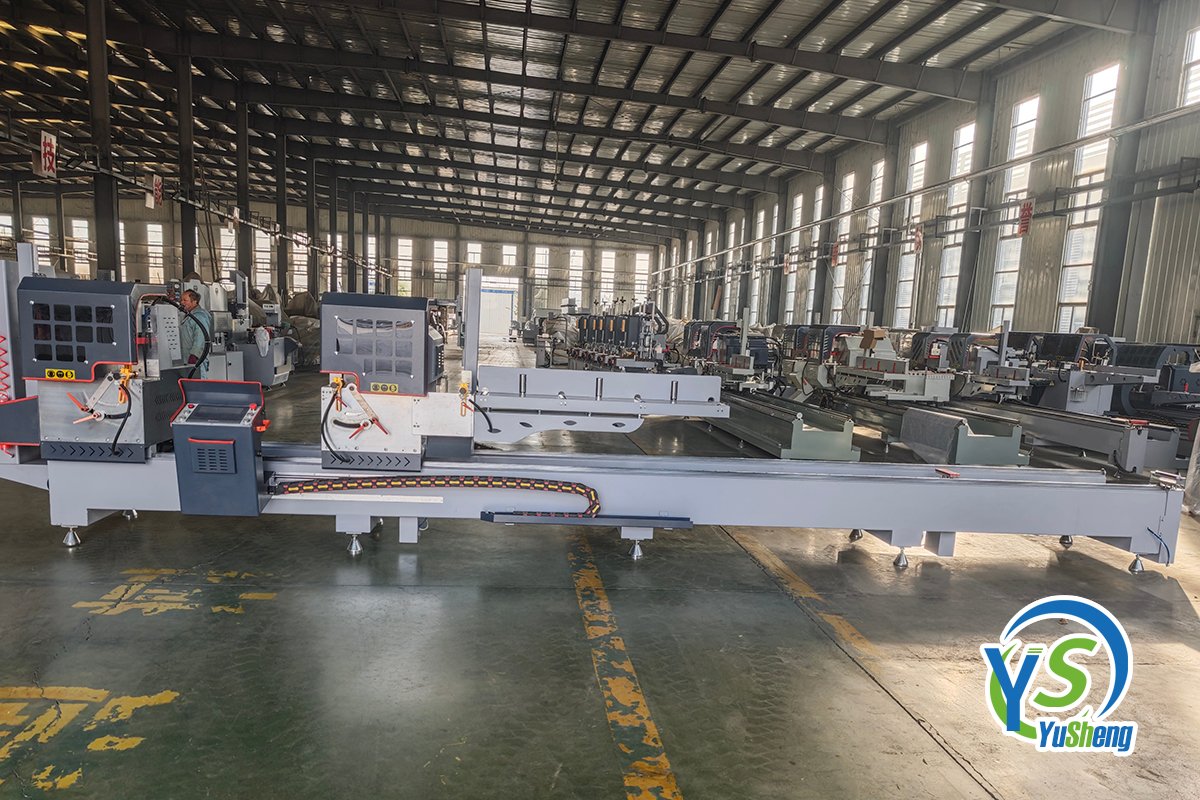
The manufacturing of aluminum and UPVC windows/doors demands precision cutting technology. The CNC high-speed double head cutting saw has emerged as a pivotal solution, combining efficiency with millimeter-level accuracy for profile processing.
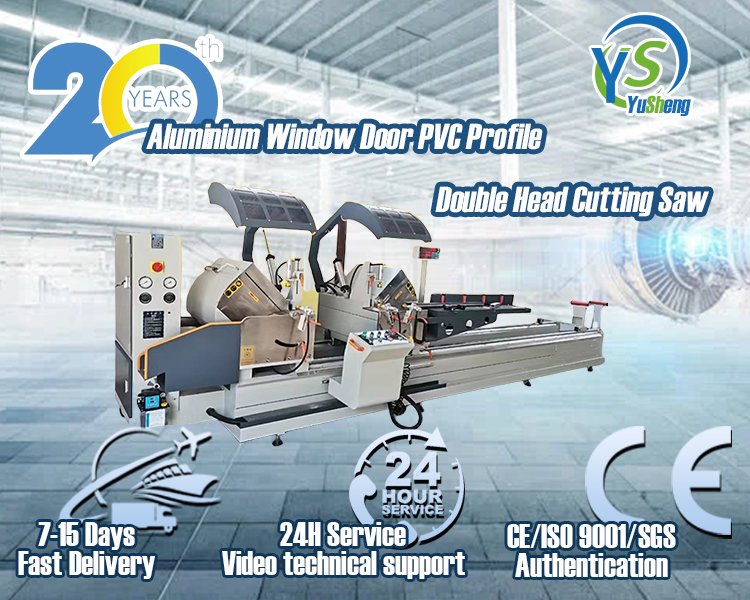
Key Features
- Dual-Head Synchronization
Equipped with two independently controlled cutting heads, this machine performs simultaneous angled cuts (typically 45°–90°) on both ends of profiles. The synchronized operation reduces processing time by 50% compared to single-head systems. - Advanced Motion Control
Linear bearing feeding systems ensure stable material movement with positioning accuracy up to ±0.1mm. Some models incorporate air-hydraulic damping cylinders to minimize vibration during high-speed cutting (reaching 1750kg feed capacity). - Material Versatility
Designed for aluminum, PVC, and UPVC profiles, the saw handles thicknesses up to 4 inches. The carbide-tipped blades maintain sharpness even when processing reinforced materials common in thermal break windows. - Smart Angle Adjustment
An integrated digital protractor allows real-time angle calibration. Operators can store 20+ preset configurations for complex miter joints required in bay windows or custom designs.
Technical Specifications
- Cutting Capacity: Max 4’ x 8’ bed size
- Speed: 3,000–4,500 RPM (variable frequency drive)
- Automation: Optional conveyor belt systems for mass production
- Safety: Laser guards and emergency stop functions
Industry Applications
This machinery is indispensable for:
- High-volume window frame fabrication
- Energy-efficient door production
- Curtain wall component manufacturing
Leading manufacturers like Shandong Truetec Machinery offer CE/ISO-certified models with modular upgrades, including dust extraction ports and RFID tool recognition systems. The technology aligns with Industry 4.0 trends through IoT-enabled performance monitoring.
By integrating such equipment, factories report 30% higher throughput while reducing material waste from cutting errors—a critical advantage in competitive construction supply chains.