
Aluminium window and door fabrication is a precision-driven manufacturing process. Even minor cutting inaccuracies can trigger a chain of production issues — loose frame joints, visible assembly gaps, excessive burrs, high rework rates, and unsatisfactory finished products. Most small and mid-sized fabricators face consistent quality problems due to outdated single-head cutting saws, manual positioning, and equipment that cannot switch flexibly between 45° and 90° cutting tasks.
The 45°/90° double head mitre saw is a purpose-built solution for aluminium profile processing. It directly targets the most common cutting errors in aluminium window production, stabilises machining accuracy, and greatly improves workshop efficiency. In this article, we break down typical production mistakes and explain how this dual-function mitre saw eliminates them from the root.
1. Uneven Profile Lengths and Inconsistent Framing
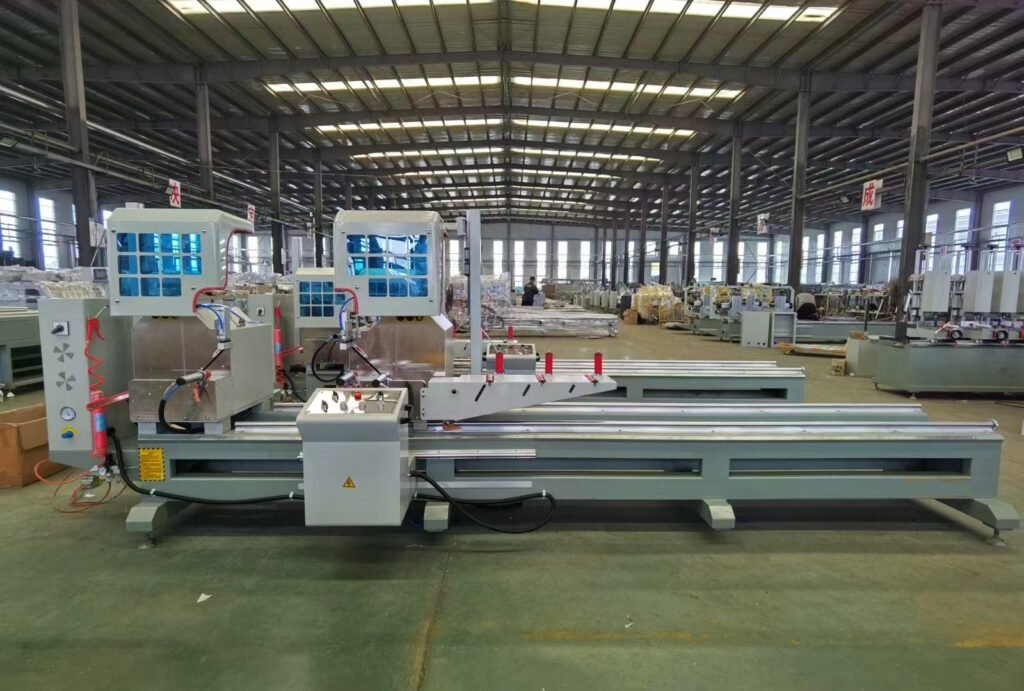
One of the most prevalent errors in aluminium window production is uneven length between paired frame profiles. When using single-head saws, workers need to measure, position, and cut each end of the profile separately. Repeated manual operation inevitably leads to cumulative tolerance errors. A length deviation of merely 0.5mm is enough to cause misaligned window frames, uneven splicing gaps, and failed assembly.
Equipped with dual synchronous cutting heads, the 45°/90° double head mitre saw completes cutting on both ends of an aluminium profile in one single clamping. The fixed precision positioning system locks the cutting dimension, requiring no secondary measurement or trimming. Whether processing batch window frames or custom-sized profiles, the machine maintains uniform length accuracy for every workpiece, completely solving length inconsistency issues.
2. Angle Deviations on 45° Mitre & 90° Straight Cuts
Aluminium window manufacturing requires frequent switching between 45° mitre cutting for frame corner splicing and 90° straight cutting for mullions and auxiliary profiles. Traditional single-function saws suffer from loose guide rails, unstable positioning, and manual angle calibration errors. Off-angle cuts result in poor corner fitting, open joints after assembly, and reduced window tightness and structural stability.
Different from ordinary mitre saws, the 45°/90° double head mitre saw supports one-key switching between 45° and 90° cutting modes. Both saw heads adopt factory-calibrated precision angle structures with rigid anti-deformation frames. The synchronous operation of dual heads ensures identical angles at both ends of the profile. No matter for standard 45° corner frames or vertical 90° structural profiles, it delivers standard, error-free cutting effects and perfect splicing results.
3. Burrs, Scratches and Profile Deformation
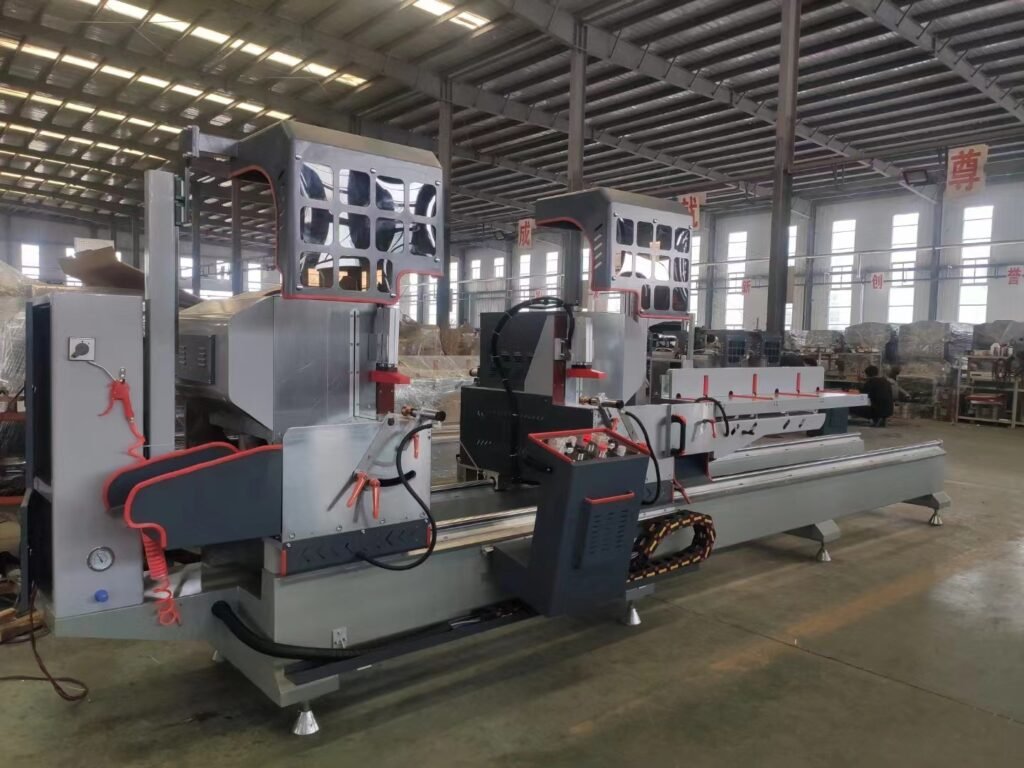
Aluminium alloy is a soft and lightweight material. Improper cutting speed, dull blades, insufficient profile support or unstable clamping will cause tool dragging, material tearing, heavy burrs and profile surface deformation in production. Workers have to spend plenty of time on manual deburring and polishing, which seriously delays production progress. Severe deformation will even lead to direct scrap of profiles.
This dual-purpose double head mitre saw is fitted with high-hardness carbide saw blades, featuring smooth cutting and low wear. It adopts pneumatic integrated clamping and full-profile support design, which firmly fixes thin-walled aluminium profiles without extrusion deformation. The optimized cutting trajectory effectively avoids edge tearing and burr generation. Workpieces come off the machine with smooth, clean cut surfaces, greatly reducing post-processing workload.
4. Low Production Efficiency and Severe Human Error
Traditional cutting processes rely heavily on manual operation: repeated positioning, clamping, single-end cutting and profile flipping. The whole process is cumbersome and time-consuming, and human errors such as mismeasurement and misplaced cutting are unavoidable. For mass production of aluminium windows and doors, this outdated workflow becomes a major production bottleneck, restricting factory output.
The 45°/90° double head mitre saw simplifies the entire processing workflow. After one-time feeding and clamping, dual-head simultaneous cutting is completed automatically. It eliminates repeated manual positioning and flipping steps. The flexible switching of two cutting angles also avoids frequent equipment replacement for different processing needs. It significantly shortens single-piece processing cycle, improves workshop throughput, and lowers error rates caused by manual operation.
5. Poor Batch Consistency and Unstable Quality
For engineering orders and batch custom aluminium windows, unified dimensional accuracy and cutting standards are the core of product quality. Manual adjustment and ordinary cutting equipment have poor repeatability. With the extension of working hours and component wear, cutting tolerances drift continuously, leading to inconsistent quality of products in the same batch and frequent rework.
Modern 45°/90° double head mitre saws are equipped with digital precise positioning systems, which can store multiple sets of custom size parameters. After presetting the cutting angle and dimension, the machine can achieve fully consistent repeated cutting for a long time. Batch processed window profiles maintain unified precision, stable splicing effect and extremely low defective rate, helping manufacturers form standardized production processes.
Final Conclusion
Most cutting problems in aluminium window production are not caused by unskilled workers, but by limited processing equipment. Uneven lengths, angle deviations, burr defects and low efficiency are common pain points restricting the development of aluminium profile processing factories.
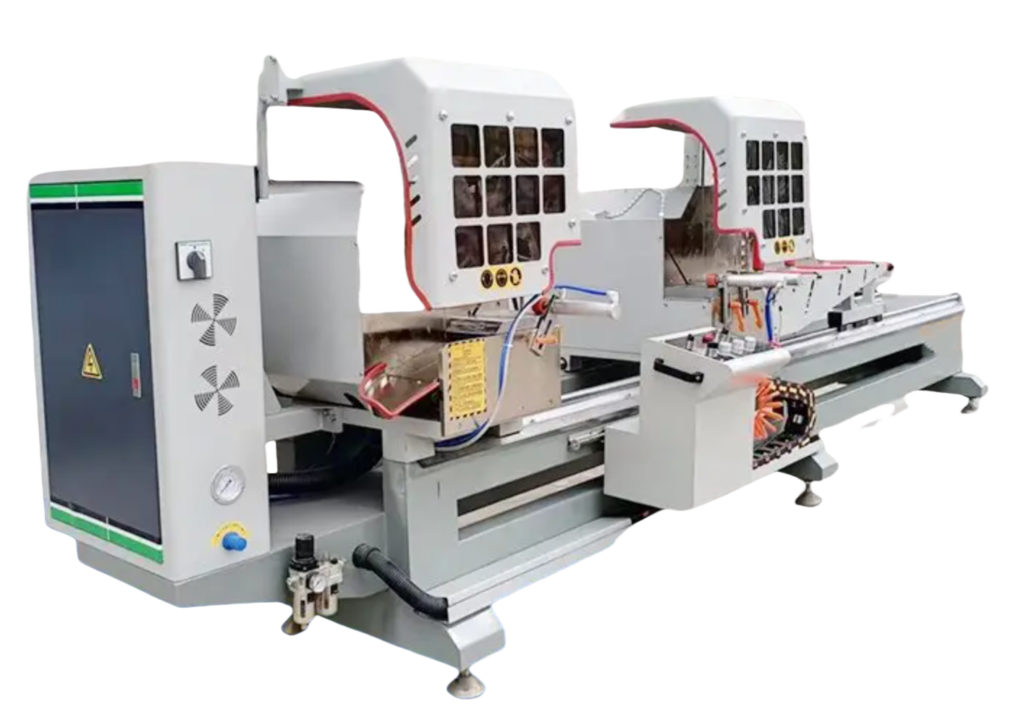
The 45°/90° double head mitre saw solves these core production problems with dual-head synchronous cutting, dual-angle flexible switching, stable clamping and high-precision positioning. It not only improves the surface quality and assembly accuracy of aluminium window profiles, reduces rework and material waste, but also greatly boosts production capacity and batch quality stability. For aluminium window and door fabricators pursuing high-precision, high-efficiency and standardized production, this equipment is an essential core processing machine.

