
In the competitive advertising sign and logo manufacturing industry, precision and efficiency determine product quality and profit margins. Traditional manual bending for metal letters is time-consuming, inconsistent, and highly dependent on worker experience, making it difficult to meet modern mass production and high-precision customization demands. This is where an aluminum and stainless steel letter bending machine becomes essential for sign factories worldwide. It streamlines the entire metal letter forming process, delivers uniform bending results, and drastically cuts down manual errors. This article breaks down its core features, complete working principle, and practical application advantages for commercial sign production.
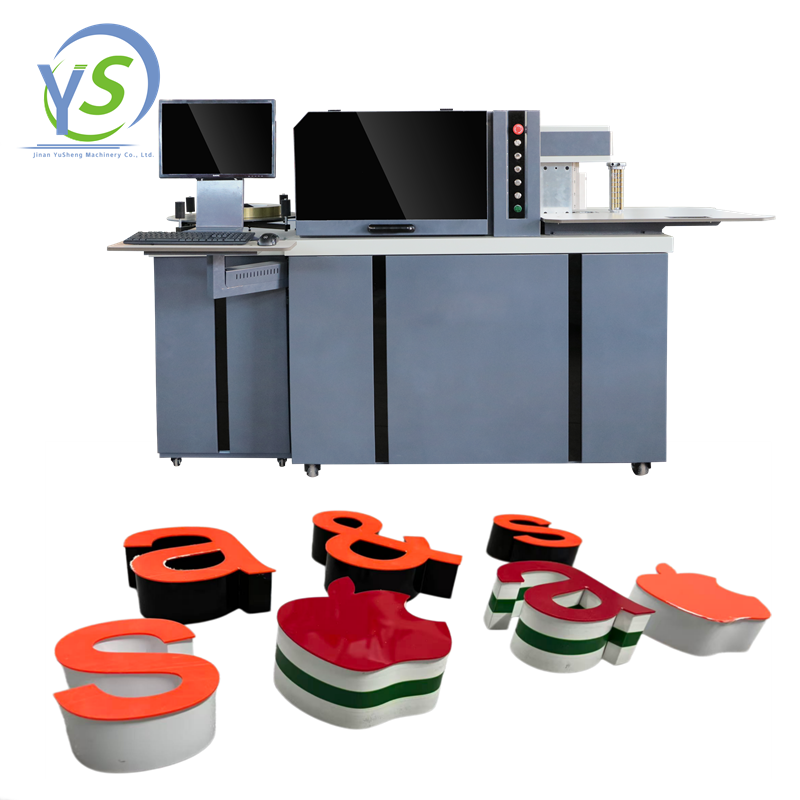
Core Features of Aluminum & Stainless Steel Letter Bending Machines
Professional letter bending machines are specially optimized for thin metal profile processing, perfectly catering to aluminum alloy and stainless steel materials commonly used in luminous signs, 3D logos, and decorative letters. Unlike universal bending equipment, it targets the unique needs of letter shaping with highly practical industrial features.
1. Dual Material Compatibility
This machine supports stable bending of both soft aluminum profiles and high-hardness stainless steel sheets, two of the most mainstream materials in the advertising industry. It adjusts bending pressure and speed intelligently according to material hardness, effectively avoiding common problems such as aluminum profile deformation and stainless steel edge cracking. Whether for thin aluminum luminous letters or thickened stainless steel decorative letters, it maintains smooth and neat bending edges without secondary trimming.
2. High Precision CNC Automatic Control
Equipped with an intelligent CNC operating system, the device allows users to input letter sizes, bending angles, and radian parameters directly. The system automatically calculates the bending path and positioning, achieving micron-level processing accuracy. It eliminates the angle deviation and size inconsistency prevalent in manual bending, ensuring every finished letter has a uniform specification—critical for high-end commercial sign projects and batch order production.
3. Integrated Automatic Feeding and Forming
Featuring one-key automatic feeding, positioning, bending, and cutting integration, the machine greatly simplifies the production process. Workers only need to set parameters and place raw materials, with no repeated manual adjustment required during operation. This automated design not only improves production efficiency by 3–5 times compared with traditional manual work but also reduces labor costs and lowers the threshold for new worker operation.
4. Customizable Bending Diversity
It supports diverse bending forms, including right-angle bending, arc bending, irregular curve bending, and closed frame forming. It can process various complex English letters, Chinese characters, brand logos, and special-shaped decorative characters, fully meeting personalized customization needs from simple daily signs to high-end creative advertising works.
5. Stable and Durable Industrial Structure
Built with thickened industrial steel frames and high-precision customized bending dies, the machine runs stably for a long time without vibration or displacement. The wear-resistant die design ensures long-term processing accuracy, reducing later maintenance and replacement costs. It is fully adapted to high-intensity continuous operation in commercial sign factories.
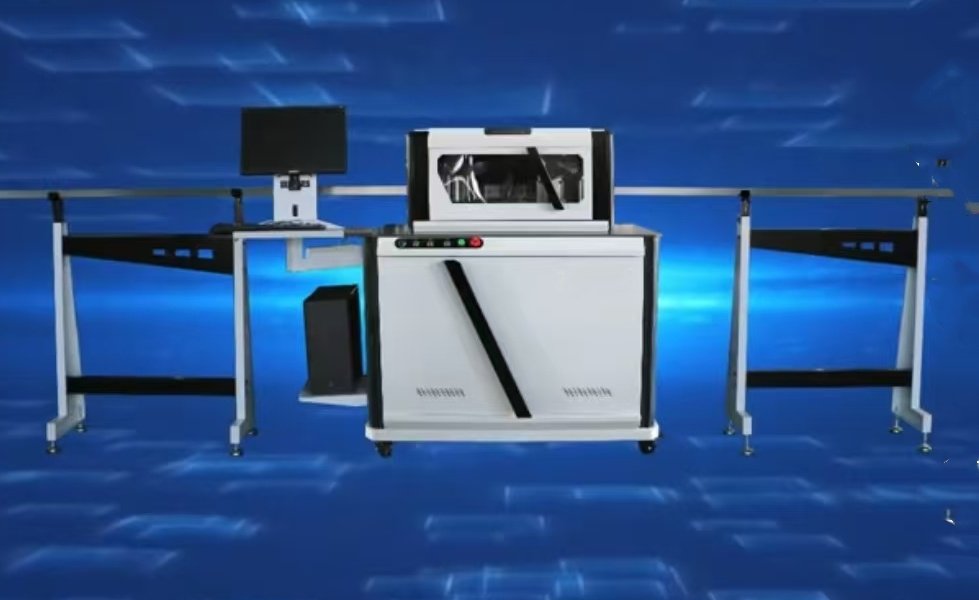
Working Principle of Metal Letter Bending Machines
The working process of the aluminum and stainless steel letter bending machine follows a standardized and intelligent mechanical logic, which can be divided into four core steps, realizing full automation from raw material input to finished letter forming.
Step 1: Parameter Setting and Program Import
Operators input the required letter specifications, bending angles, and material thickness parameters into the CNC system. For batch or customized complex patterns, pre-made processing programs can be imported directly. The system will automatically identify material attributes and match the optimal bending pressure and operating speed to prepare for formal processing.
Step 2: Automatic Feeding and Precise Positioning
After the program is confirmed, the automatic feeding system pushes the aluminum or stainless steel profile into the processing area. The high-precision sensor performs real-time positioning calibration to ensure the raw material is fixed at the optimal processing position, avoiding position deviation caused by material deviation or mechanical vibration.
Step 3: Graded Bending and Shaping
According to the preset path, the bending die performs graded and segmented bending on the metal profile. For hard stainless steel materials, the machine adopts gradual pressure bending to prevent material cracking; for soft aluminum profiles, it uses constant-pressure forming to avoid extrusion deformation. The whole process realizes one-time forming of angles and arcs without multiple repeated processing.
Step 4: Cutting and Finished Output
After the bending and shaping are completed, the precision cutting device automatically cuts the profile according to the set size. The finished metal letter is output smoothly with flat notches and smooth edges, requiring basically no manual polishing or trimming, which directly improves the yield rate of finished products.
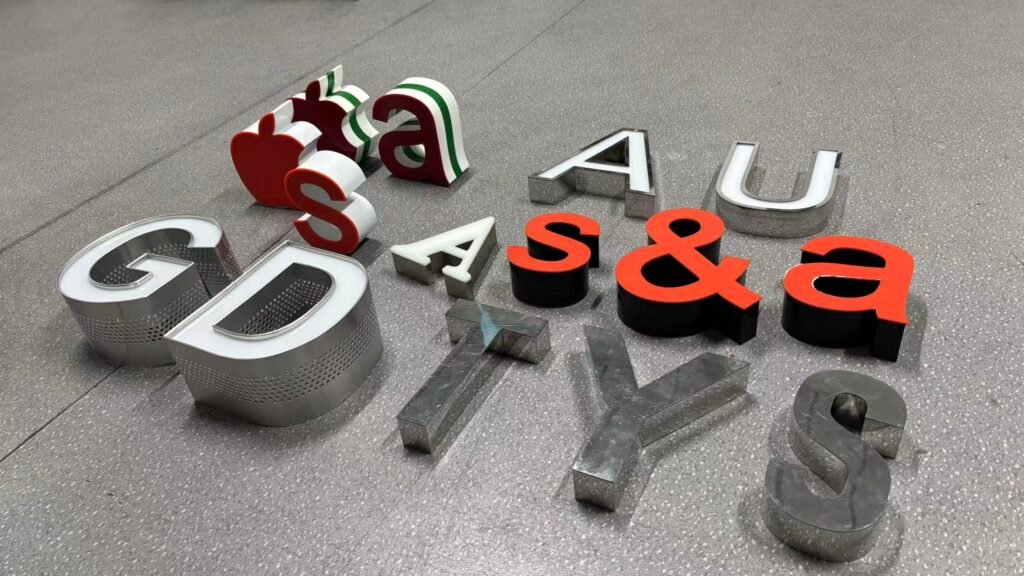
Why Choose a Professional Letter Bending Machine for Sign Production?
For advertising sign manufacturers, stable processing accuracy and efficient production capacity are the core of market competitiveness. Traditional manual bending relies heavily on worker proficiency, leading to unstable product quality, high defective rates, and inability to support large-order delivery. A dedicated aluminum and stainless steel letter bending machine completely solves these pain points.
It not only unifies product standards and improves the overall aesthetics of signs but also shortens the production cycle of customized orders. For small and medium-sized sign factories, it reduces labor dependence; for large-scale manufacturers, it realizes standardized and automated batch production, greatly improving market competitiveness.
Final Words
Aluminum and stainless steel letter bending machines are indispensable core equipment in the modern advertising sign industry. With dual-material adaptability, high-precision CNC control, and efficient automatic forming capabilities, they replace inefficient and unstable manual processing methods. Understanding its core features and working principle helps sign manufacturers select more suitable processing equipment, optimize production processes, and create higher-quality metal letter sign products.

