
If you’re running an aluminum fabrication shop, you know the drill. Your team spends hours manually calculating how to cut profiles for a window or door order. You try to fit every piece onto a 6-meter bar, but there’s always that awkward offcut left over—too short to use, too long to ignore. By the end of the month, your scrap bin is full, and your material costs are eating into your margins.
This is exactly where a CNC aluminum profile single-head cutting saw with automatic nesting changes the game. It’s not just another machine on the floor; it’s a tool designed to solve one specific problem: maximizing material yield while keeping precision consistent.
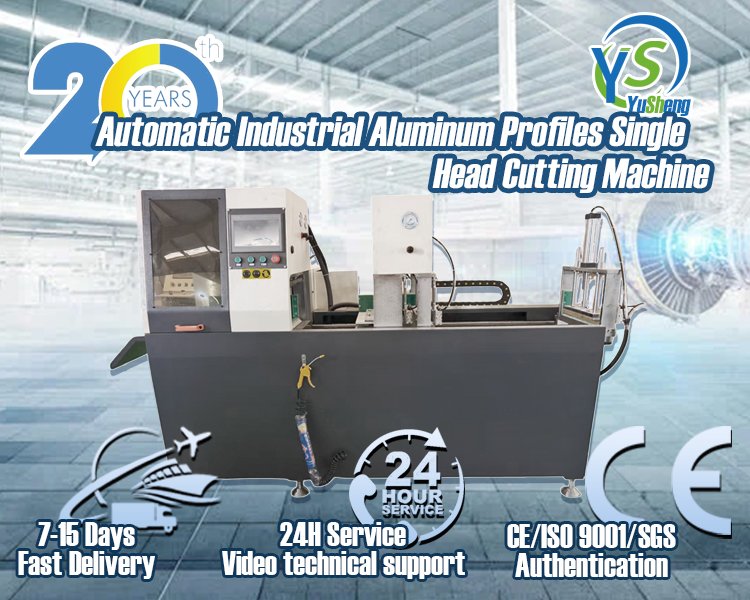
Why “Nesting” Matters More Than You Think
Let’s be honest. Manual cutting is fine for simple, one-off jobs. But when you’re handling bulk orders for architectural aluminum or industrial frames, manual planning is a leak in your budget.
The “nesting” software inside a CNC single-head saw does the heavy lifting. You input your required lengths and quantities, and the system automatically calculates the most efficient layout across your stock bars. It shuffles the pieces like a puzzle, finding combinations you’d likely miss on paper. In real-world scenarios, this often reduces material waste by 15–20%. For a shop processing tons of aluminum monthly, that savings pays for the machine faster than you’d expect.
The Single-Head Advantage: Simplicity Meets Precision
You might wonder, “Why a single-head saw instead of a double-miter setup?”
For many fabricators, especially those dealing with varied profile lengths and complex cut lists, a single-head design offers better flexibility. Here’s why it works:
- Sequential Cutting Efficiency: The servo-driven feeding system pulls the profile forward after each cut. It’s ideal for processing long bars where you need multiple different lengths from a single stock piece. The machine doesn’t stop to reposition a second head; it just keeps cutting.
- Bur-Free Results: A high-speed spindle (usually 3kW to 5.5kW) paired with a quality hard-alloy blade ensures clean cuts. The pneumatic clamps hold the profile tight, eliminating vibration. This means less time spent deburring edges downstream.
- Angle Versatility: While it’s a single-head unit, most models allow angle adjustments between 45° and 135°. You can handle straight 90° cuts for structural frames and mitered corners for window assemblies without switching machines.

Built for the Shop Floor, Not Just the Showroom
As someone who’s visited dozens of factories, I’ve seen machines that look great in brochures but struggle under daily pressure. A reliable CNC nesting saw needs to handle the grit of real production.
Look for features like linear guide rails for the feeding axis. They maintain positioning accuracy within ±0.1mm even after years of use. The control interface should be straightforward—an industrial touch screen where operators can import CAD data or type in cut lists directly. If your team needs a PhD to operate it, it’s not the right fit.
Also, check the dust collection setup. Aluminum chips are messy. A well-designed saw directs swarf away from the guide rails and into a collection bin, reducing downtime for cleaning.
Who Actually Needs This Machine?
This isn’t for everyone. If you’re only cutting identical lengths all day, a simpler pneumatic saw might suffice. But if you’re in any of these sectors, a CNC nesting saw is a smart move:
- Architectural Fabricators: Making custom windows, doors, or curtain walls where every opening size is different.
- Industrial Profile Users: Building conveyor frames, automation enclosures, or solar mounting structures. These projects often involve complex bills of materials with varying lengths.
- Job Shops: Handling mixed batches where material optimization directly impacts your quote competitiveness.

Conclusion
Investing in a CNC aluminum single-head cutting saw isn’t just about upgrading your equipment list. It’s about tightening your production process. You get consistent precision, faster throughput, and most importantly, you stop throwing money away in the scrap bin.
If you’re still calculating cuts by hand, it’s time to let the software do the math. Your bottom line will thank you.
Ready to optimize your aluminum cutting process? Reach out to discuss how our nesting solutions can fit your production line.

