
In the sign-making industry, producing clean and professional 3D channel letters requires more than a good design. The metal strip used to form the sides of the letter needs to be cut, slotted, and bent accurately. When these steps are done manually, production can be slow and the final result can vary from one letter to another.
A CNC Automatic Channel Letter Bending Machine offers a more efficient way to handle this process. By combining automatic feeding, slotting, and bending in one machine, it helps sign manufacturers produce accurate channel letters with less manual work.
For companies making LED signs, illuminated letters, storefront signs, advertising displays, and custom 3D lettering, a CNC channel letter bender can become an important part of the production line.
What Is a CNC Automatic Channel Letter Bending Machine?
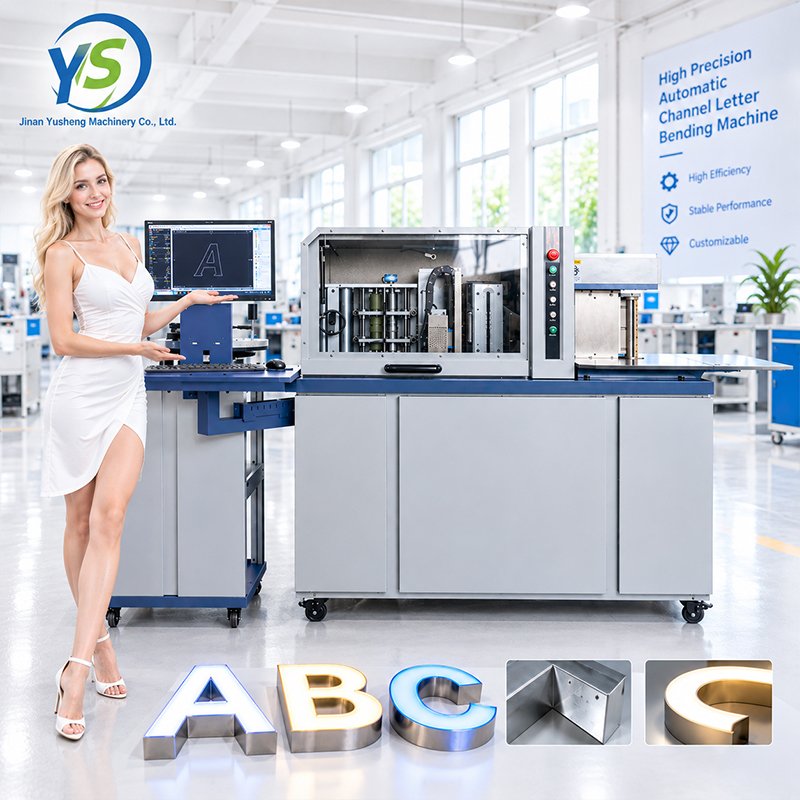
A CNC Automatic Channel Letter Bending Machine is specialized equipment designed to turn flat metal strips into the shaped side walls of 3D channel letters.
Instead of manually measuring and bending every section of a letter, the operator can import the digital letter design into the machine’s control software. The machine then follows the programmed path to feed, slot, and bend the material according to the design.
Depending on the machine configuration, commonly supported file formats include DXF, AI, and PLT. The automatic process makes it much easier to reproduce the same letter shape accurately, especially when a sign project contains many letters or repeated designs.
Modern channel letter bending machines are commonly used for aluminum, stainless steel, galvanized sheet, and other suitable metal strips. Material capacity varies by model, but many machines are designed for relatively thin strips used in illuminated signage.
Why Are Automatic Channel Letter Benders Becoming More Popular?
Traditional channel letter fabrication often involves several manual operations. An operator may need to measure the material, mark bending points, make slots, bend the strip, and check the finished shape.
This works for small orders, but it becomes difficult when production volume increases.
A CNC automatic system changes the workflow. Once the design and processing parameters are prepared, the machine can carry out the main forming operations automatically.
The result is a simpler production process:
Design → File Input → Automatic Feeding → Slotting → Bending → Finished Letter Channel
This is particularly useful for sign shops that receive customized orders every day. Instead of spending a large amount of time on manual bending, operators can focus on preparing materials, checking finished letters, and handling other production tasks.
Automatic Feeding, Slotting and Bending
One of the main advantages of a CNC channel letter bending machine is that several processes can be integrated into one production cycle.
Automatic Feeding
The feeding system moves the metal strip through the machine at a controlled speed. A properly designed feeding and clamping system helps maintain stable positioning and can reduce marks or scratches on the material surface.
This is important for aluminum and stainless steel strips because the visible surface of the finished channel letter needs to remain clean.
Automatic Slotting
Before a metal strip can follow a complicated letter shape, certain areas need to be slotted or notched.
The CNC system can determine where these slots are required based on the digital design. Some machines use a high-precision guide screw and specialized cutting blade for this process.
Automatic slotting eliminates much of the measuring and marking work associated with manual fabrication.
Automatic Bending
After slotting, the machine bends the material according to the programmed shape.
Straight sections, arcs, corners, and more complex contours can be produced automatically depending on the machine design and available bending system.
Some advanced machines use upper and lower bending axes or different bending systems for different materials, helping achieve smoother curves and more consistent results.
Better Accuracy for 3D Channel Letters
Accuracy is one of the biggest reasons sign manufacturers choose CNC equipment.
A channel letter may contain dozens of individual curves and corners. If one section is bent incorrectly, the complete letter may not fit the backing plate correctly.
A CNC automatic channel letter bender uses programmed dimensions rather than relying entirely on manual measurements. This helps improve repeatability when producing multiple letters with the same design.
For example, if a customer orders the same company logo for 20 stores, the manufacturer can use the same digital file and production parameters to create consistent letter channels.
This repeatability can be especially valuable for franchise signage, retail chains, shopping centers, hotels, and large advertising projects.
Suitable Materials for Channel Letter Production
The exact material range depends on the machine model, but CNC channel letter bending machines are commonly designed to work with materials such as:
- Aluminum strip
- Flat aluminum
- Folding aluminum
- Stainless steel
- Galvanized metal
- Other suitable thin metal strips
Aluminum is particularly popular for illuminated channel letters because it is lightweight, easy to form, and suitable for many indoor and outdoor signage applications.
Some machines are specifically optimized for aluminum, while others offer separate bending systems or tooling for aluminum and stainless steel.
Before purchasing a machine, it is important to confirm the required material width, thickness, hardness, minimum bending radius, and surface finish.
What Can You Make With a Channel Letter Bending Machine?
The applications go far beyond simple alphabet letters.
A CNC Automatic Channel Letter Bending Machine can be used for many types of custom signage, including:
- LED channel letters
- 3D advertising letters
- Illuminated storefront signs
- Backlit channel letters
- Halo-lit letters
- Corporate logo signs
- Retail signage
- Hotel and restaurant signs
- Shopping mall signage
- Outdoor advertising letters
- Custom-shaped metal lettering
For sign manufacturers, this flexibility makes the machine useful for both standard production and customized projects.
LED Channel Letters and Illuminated Signage
One of the most common applications is the production of LED channel letters.
A typical channel letter consists of a front face, a side wall, a back panel, and an internal lighting system. The metal side wall gives the letter its three-dimensional shape and determines the overall depth and appearance.
The channel letter bending machine is mainly responsible for forming this side wall accurately.
After bending, the formed metal channel can be assembled with acrylic, aluminum, LED modules, a back panel, or other components according to the sign design.
For illuminated signage manufacturers, accurate side-wall fabrication is important because even small dimensional errors can affect the final assembly.
Reduce Manual Work Without Sacrificing Flexibility
Automation does not mean the machine is limited to mass production.
In fact, CNC equipment can be particularly useful for companies that produce many different custom signs.
A digital design can be changed quickly, allowing the same machine to produce different letters, logos, sizes, and shapes.
This is one of the key advantages of a CNC automatic channel letter bender over traditional manual bending tools.
Instead of building a separate bending process for every project, the manufacturer can adjust the digital design and processing parameters according to the new order.
Software Makes the Production Process Easier
Modern channel letter bending machines typically use dedicated software to control feeding, slotting, and bending operations.
The operator can prepare the letter design in compatible design software and import the required file into the machine system.
Depending on the machine, the software can also control parameters such as groove depth, material thickness, bending position, and other processing settings.
This reduces the amount of manual calculation required during production.
For a new operator, this can also make the learning process easier than traditional manual fabrication methods.
A Good Choice for Growing Sign Businesses
For a small sign shop, purchasing a CNC automatic channel letter bending machine is not only about increasing production speed.
It is also about making production more predictable.
When order volume increases, manual bending can quickly become a bottleneck. One experienced operator may spend a significant amount of time producing individual letters, particularly when the designs contain complicated curves.
With CNC automation, the machine can handle repetitive forming operations while the operator manages other parts of the production process.
This can help a sign company take on more orders without simply adding more manual labor.
What Should You Consider Before Buying?
Not every channel letter bending machine is the same. Before choosing a machine, it is worth looking at several key factors.
1. Material Compatibility
Check whether the machine supports the materials you normally use, such as aluminum or stainless steel.
2. Material Thickness and Width
Make sure the machine’s working range matches your most common channel letter materials.
For example, some machines are designed for material widths around 20–200 mm and thicknesses around 0.4–2 mm, while other models have different ranges.
3. Minimum Bending Radius
If your business produces small letters or designs with tight curves, minimum bending radius is especially important.
4. Software Compatibility
Check whether the machine supports the file formats used by your design team, such as DXF, AI, or PLT.
5. Bending System
Different machines may use different bending mechanisms. If you frequently process both aluminum and stainless steel, ask whether the machine provides separate tooling or bending systems for different materials.
6. After-Sales Support
CNC equipment is an investment. Good technical support, software assistance, spare parts availability, and operator training can make a significant difference over the long term.
CNC Channel Letter Bending Machine vs. Manual Bending
The difference between manual and CNC bending becomes more obvious as production volume increases.
With manual fabrication, the operator has greater control over each individual piece, but the process can be time-consuming and heavily dependent on experience.
With CNC automation, the production process becomes more standardized.
| Feature | Manual Bending | CNC Automatic Bending |
|---|---|---|
| Production speed | Lower | Higher |
| Repeatability | Depends on operator | More consistent |
| Complex shapes | More difficult | Easier to reproduce |
| Labor requirement | Higher | Lower |
| Digital file integration | Limited | Supported |
| Large batch production | Time-consuming | More efficient |
| Customized designs | Possible | Highly flexible |
For occasional sign production, manual tools may still be practical. But for professional sign manufacturers handling regular orders, CNC automation can offer a clear production advantage.
The Future of Channel Letter Manufacturing
Signage is becoming increasingly customized. Customers want unique logos, illuminated letters, special shapes, and distinctive storefront designs.
At the same time, sign manufacturers need to deliver these products faster and maintain consistent quality.
This is where CNC automation becomes valuable.
A CNC Automatic Channel Letter Bending Machine combines digital design with automated metal forming, creating a more streamlined production process for modern sign shops.
Instead of treating every letter as a separate manual fabrication job, manufacturers can build a repeatable workflow from design to finished metal channel.
Final Thoughts
A CNC Automatic Channel Letter Bending Machine is more than a bending machine. It is a production tool designed to simplify the fabrication of modern 3D signage.
By combining automatic feeding, slotting, and bending, it can help manufacturers reduce manual work, improve repeatability, and handle a wider range of custom channel letter designs.
For companies producing LED channel letters, illuminated signs, advertising letters, corporate logos, and custom 3D signage, investing in the right CNC channel letter bender can make the production process faster and easier to manage.
The best machine, however, depends on the materials, letter sizes, bending radius, production volume, and types of signage you manufacture. Before making a purchase, it is worth discussing your actual samples and production requirements with the machine manufacturer so the bending system, tooling, and software can be properly configured.

