
Introduction
If you run a small aluminum processing workshop focused on window frames, curtain wall profiles, railing extrusions or custom decorative aluminum strips, upgrading bending equipment is always a tough financial call.
Most small factory owners start with low-cost single-direction hydraulic benders to save upfront cash. But as custom curved orders pile up—3D curved frames, S-shaped profiles, multi-radius architectural trim—many buyers begin researching three-axis CNC aluminum bending machines.
The core question every small fabricator asks: Is the steep extra investment on a 3-axis CNC bender truly worth it for limited daily output, tight workshop space and thin profit margins?
This practical buyer’s guide skips overblown marketing specs. We compare real-world performance, long-term running costs, ROI timelines, and outline exactly which small factories benefit most from 3-axis CNC bending, and which should stick to simpler 1/2-direction models.
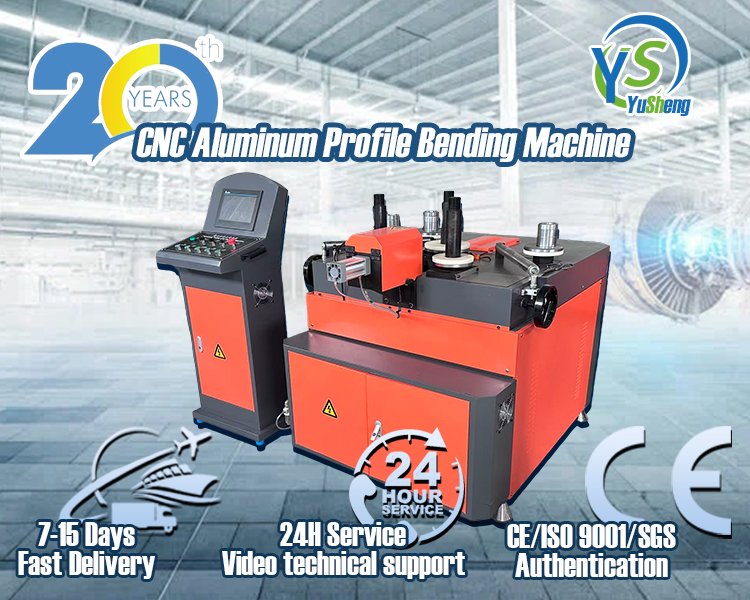
What Is a Three-axis CNC Aluminum Bending Machine, In Plain Shop Terms?
Standard single or double-direction aluminum benders only control horizontal feeding and vertical bending pressure, limited to flat 2D arcs. Every time you need a multi-plane curve, symmetrical 3D shape or alternating radius bend, workers must manually unclamp, flip and reposition profiles repeatedly.
A three-axis CNC aluminum bender adds a fully independent Z-axis servo lifting system, creating synchronized X (profile feed), Y (bending pressure roller stroke), Z (support roller height adjustment) closed-loop control.
Key practical advantages of 3-axis motion:
- Complete 2D flat arcs AND 3D space curved frames in one single clamping cycle
- Automatic spring-back compensation for aluminum’s soft extrusion property
- Store dozens of custom profile programs on the touchscreen CNC panel for one-click job switching
- No repeated manual repositioning, cutting human-induced dimensional errors drastically
It’s the entry-level CNC solution for shops that need complex curved aluminum parts without stepping up to far pricier 5-axis industrial bending equipment.
Core Pros of Three-axis CNC Aluminum Bending Machines for Small Factories
1. Massively Cuts Scrap & Rework Losses
Small workshops lose huge profit from scrapped aluminum profiles. Manual re-clamping on basic benders creates cumulative positioning deviation, uneven arc radii and surface indentation on thin-walled window extrusionsAliExpress.
3-axis synchronous servo control locks tolerance within ±0.1mm for bend radius and angle. For small shops running 50–200 custom pieces daily, scrap rates can drop from 8–12% down to under 2% after switching, directly protecting thin profit margins.
2. One Operator Handles All Complex Bending Jobs
Most small factories run lean staffing, often just one or two production workers. Traditional double-direction benders require constant workpiece adjustment for S-curves or 3D curtain wall frames, tying up full labor hours on bending alone.
With a 3-axis CNC unit, an operator loads the aluminum profile, calls up the pre-saved CNC program, and walks away to cut, punch or finish other parts while the machine completes all multi-direction bending automatically. Many small fabricators report cutting bending station labor time by 40–60% on complex orders.
3. Expands Your Product Range Without Adding Extra Machines
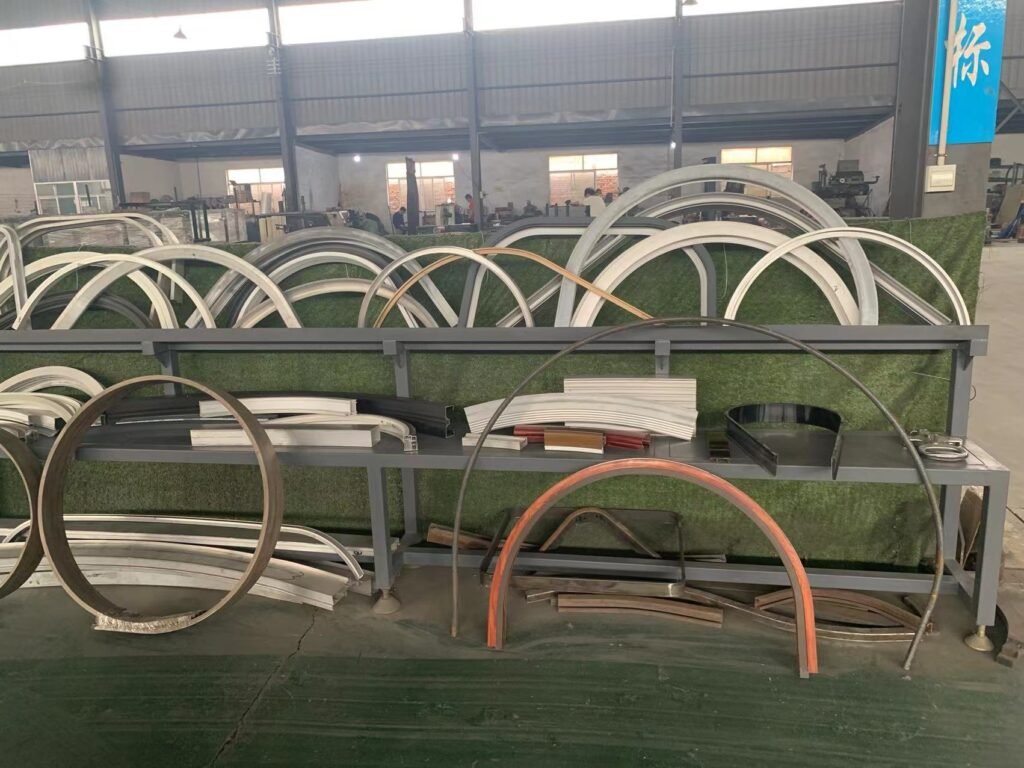
The biggest growth pain point for small aluminum shops is turning down high-margin custom orders: villa curved window frames, shower enclosure 3D aluminum borders, architectural curved curtain wall profiles, curved furniture aluminum strips and circular handrail frames.
Cheap single/double-direction benders cannot consistently produce these complex shapes. A single three-axis CNC bender covers simple single-radius arcs and advanced 3D curved profiles in one machine, letting you bid higher-value custom projects without purchasing multiple separate bending devices.
4. Consistent Repeatability for Small Batch Custom Orders
Small factories rely heavily on repeat small-batch client orders (10–50 pieces per job). Manual adjustment on non-CNC benders creates slight differences between batches, leading to client complaints and rework.
3-axis CNC saves every product’s bending parameters, so the first and 50th finished aluminum frame share identical dimensions. This stability builds long-term client trust, especially for architects, window wholesalers and furniture brand buyers who demand uniform finished parts.
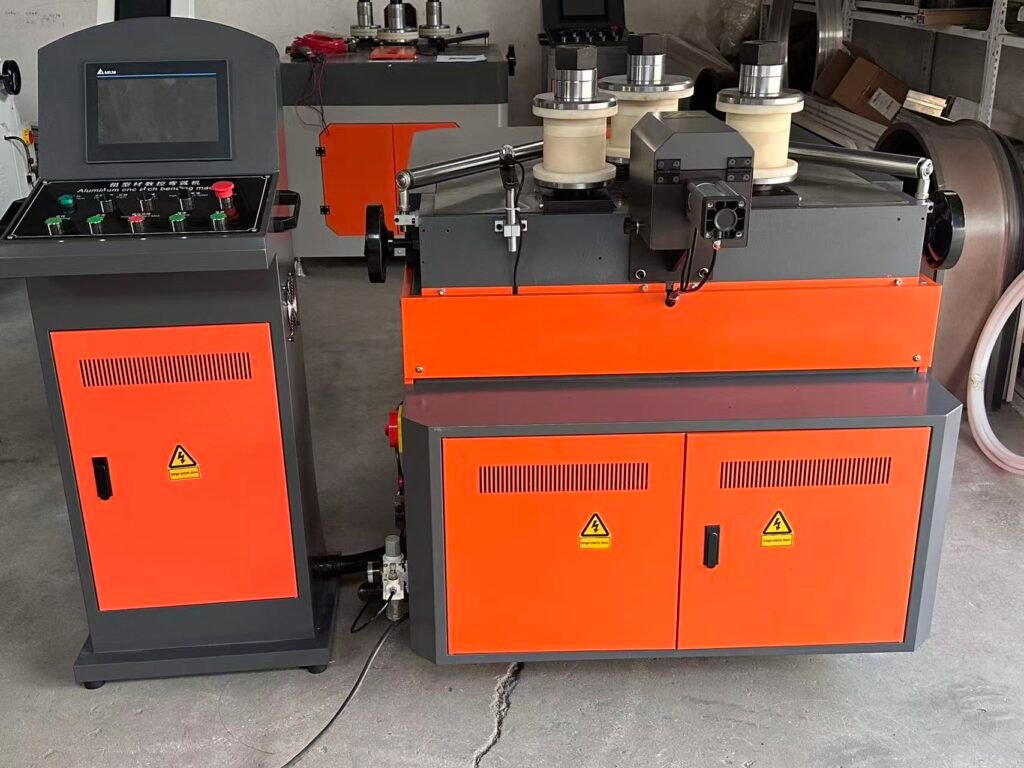
Real Drawbacks Small Factories Must Calculate Before Purchasing
1. Higher Upfront Capital Outlay
Entry-level single hydraulic aluminum benders cost a fraction of a basic three-axis CNC model. Even compact bench-style 3-axis units carry a much higher price tag, a major barrier for startups with limited equipment budgetsAlibaba.co….
For shops with monthly turnover under $15,000 and zero complex curved orders, the upfront investment takes far too long to recoup.
2. Larger Workshop Footprint & Foundation Requirements
Three-axis CNC benders integrate three sets of servo drives, independent hydraulic circuits and extended feeding frames. They occupy 30–50% more floor space than compact single-direction benders.
Many small fabrication units operate in narrow rented workshops with limited ground area; squeezing a full 3-axis machine will disrupt your entire production layout. The unit also requires level, reinforced ground to avoid bending sync errors during long runs.
3. Higher Long-Term Maintenance & Training Costs
Three servo motors, three-axis encoders and dual hydraulic pressure systems mean more wearable components compared to simple single-direction benders. Annual maintenance costs for lubrication, seal replacement and servo calibration run higher.
New operators also need 1–2 days of CNC programming training to master axis parameter adjustment, versus half a day of basic training on manual hydraulic benders. If your staff has zero CNC experience, you’ll face extra training downtime.
4. Overkill If All Your Orders Are Simple Single-Arc Profiles
If over 85% of your monthly output is standard single-radius window frames and straight curved handrails with no S-shapes or 3D curves, the Z-axis 3D bending function will sit idle most days. You pay extra for technology you never use, dragging down overall equipment ROI.
When Should A Small Factory Buy A Three-axis CNC Aluminum Bending Machine?
Invest in a 3-axis CNC aluminum bender if any of these match your daily operation:
- Over 30% of your monthly orders are custom curved frames, S-shaped extrusions or 3D architectural curtain wall aluminum profiles
- You regularly turn down high-value custom jobs due to limited bending capacity on old manual equipment
- Your workshop only has 1–2 production staff, and you want to cut labor waste on bending stations
- You plan to expand product lines into villa windows, curved shower frames or decorative aluminum furniture within 1–2 years
- Scrap waste from inconsistent manual bending eats more than 5% of your monthly material cost
- Local clients (architects, building contractors) increasingly request tight-tolerance uniform curved aluminum components
When Should Small Factories Skip The 3-Axis CNC Upgrade?
Stick with affordable single or double-direction hydraulic benders if:
- More than 85% of your production is basic single-arc standard window and railing frames
- Your monthly equipment budget is tight, and you cannot cover the higher purchase payment without 6+ months of ROI delay
- Your workshop layout is extremely narrow with no extra space for larger CNC machinery
- Your order volume is low (under 100 bending pieces daily), and you rarely receive custom curved work
- Your team has no CNC operation experience, and you cannot spare time or budget for training
How To Calculate Rough ROI For A Small Factory 3-Axis CNC Bender
For most small aluminum shops producing mixed simple + complex curved parts, the total return on investment typically falls between 10–16 months, calculated from three key savings:
- Labor cost reduction from fewer operator hours on bending
- Material savings from drastically lower scrap rates
- Extra revenue from accepting previously unprocessable high-margin custom curved orders
If your monthly combined savings + new custom order profit exceeds 1/12 of the machine’s full purchase price, the 3-axis CNC unit is a worthwhile investment for your small factory.
Common Buyer Misconceptions To Avoid
- Misconception: All small shops need CNC bending to stay competitive Fact: Shops focused purely on standard simple aluminum frames gain zero financial benefit from a 3-axis upgrade; cheaper hydraulic models deliver identical results at a fraction of the cost.
- Misconception: Three-axis machines are impossible for small teams to operate Fact: Modern touchscreen HMI panels include preloaded aluminum profile libraries, CAD file import and automatic parameter calculation. Basic operation becomes intuitive after short training.
- Misconception: 3-axis CNC benders break down constantly Fact: Reputable manufacturers use closed-loop servo systems and standardized spare parts. Daily maintenance only requires routine roller lubrication and encoder inspection; breakdown frequency is comparable to standard hydraulic benders with proper care.
Final Verdict
A three-axis CNC aluminum bending machine is not a universal must-buy for every small aluminum fabrication factory—but it delivers clear, measurable profit growth for small shops targeting custom, high-precision curved aluminum products.
If your business relies on standard simple window and railing profiles with minimal custom curved orders, hold off and stick with cost-effective single or double-direction hydraulic benders.
If custom 3D curved frames make up a meaningful portion of your order book, you struggle with high scrap waste and labor bottlenecks, or you want to expand into higher-value architectural aluminum projects, the 3-axis CNC bending machine will quickly pay back its upfront cost and boost your factory’s long-term competitiveness.
Before placing your order, sort out your mainstream product drawings and monthly order breakdown, then consult machinery suppliers to select a compact small-factory tailored three-axis model matching your profile size and output volume.

